 Kindoru
Research partnerships
Research: two tracks.
Kindoru is an early-stage project run by an independent founder. We're testing two things, separately: (1) introduction quality, whether suggested introductions are useful to the people who get them, and (2) safety research, whether scam patterns can be flagged early enough to matter. We are not selling a finished product. Contact: hello@kindoru.com.
Track 1 · Matching evidence (not yet measured)
We have no matching data yet. There are no users. In a first small pilot within one existing London community, we plan to measure:
- Share of suggested introductions that people accept
- Share of accepted introductions that lead to an actual conversation
- Meetups that actually happen
- Return rate: people who come back for another introduction
- Cost per introduction
None of these have been measured. We'll publish them here, good or bad.
Track 2 · Safety research
The current prototype
- A message-level scam-signal detector that scores agent or user conversations for patterns such as pushes off-platform, investment pitches and personal-data probing.
- A signed, single-use handoff token for exchanging contact details only after both people explicitly approve. In lab tests it blocked 1,001 of 1,001 forged or replayed tokens.
- Account checks: one passkey per account, plus device signals (being tested). This does not establish that an account is a unique human.
Honest limitations
- On 83 real romance-scam conversations, it caught 0 within the first 25 messages and 36% (27–47%) by the end, usually after about 185 messages. That is too late to protect anyone.
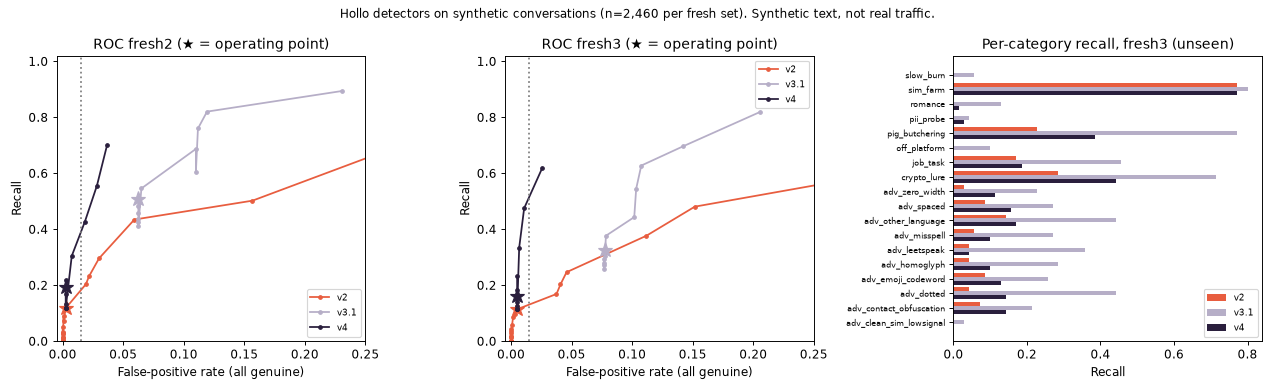
- On synthetic test sets it caught 16–19% of scams across all categories.
- False-alarm rates were measured against short textbook dialogues; real-world rates could be higher.
- Weakest areas: off-platform requests, slow-burn romance scams and personal-data probing.
- No users, no production deployment, no independent audit yet. Full numbers are below.
Results
Method
The detector scores each conversation message by message and raises a warning when the running score crosses a fixed threshold. Thresholds and rules were frozen before testing. We used two kinds of data:
- Synthetic sets: two held-out sets of 2,460 computer-generated conversations each (1,200 genuine, 1,260 scam across several scam types), generated after the detector was frozen.
- Real scam chats: 83 real romance-scam conversations from the public LoveFraud02 dataset, compared with 2,000 ordinary conversations from DailyDialog. We recorded whether and when (at which message) the first warning fired.
Intervals are 95% confidence intervals. Nothing has been independently reproduced.
What the numbers mean in practice
Most warnings would be wrong at a realistic scam rate. If 1 in 100 conversations is a scam, then out of 10,000 conversations the detector would catch about 36 of 100 scams (36% recall) and wrongly flag about 396 of 9,900 genuine ones (4% false alarms). Only about 8% of warnings (36 of 432) would be real scams; roughly 92% would be false.
The real-chat sample is too small for firm accuracy claims. With 83 scam conversations, the AUROC figures (0.81–0.84) are imprecise and shouldn't be read as a reliable accuracy score. The ordinary comparison chats are short textbook dialogues, so real-world false alarms could be higher.
Next: rule-based detection of off-platform requests, phone numbers, handles and wallet links from the first message, then measuring first warnings and false flags within the first 10–25 messages.
Detailed results
Detector on two held-out synthetic test sets (2,460 conversations each: 1,200 genuine, 1,260 scam), written after the detector was frozen. 95% confidence intervals in brackets.
| Measure | Set 2 | Set 3 |
|---|---|---|
| Scams caught, all categories | 19% (17–22%) | 16% (14–18%) |
| False alarms on genuine chats that mention money, crypto or handles | 0.6% | 1.2% (0.6–2.6%) |
| Forged or replayed handoff tokens blocked, in lab tests | 1,001 of 1,001 in lab tests | |
Real scam chats (public dataset)
83 real romance-scam conversations (the public LoveFraud02 dataset) compared with 2,000 ordinary everyday conversations (DailyDialog).
| Measure | Result |
|---|---|
| Scams caught within the first 25 messages | 0 of 83 (0%, 0–4.4%) |
| False alarms on ordinary chats, first 25 messages | 0.4% |
| Scams caught by the end of the whole conversation | 36% (27–47%) |
| False alarms over whole conversations | 4% (1.6–9.8%) |
| When the first warning usually came | after about 185 messages |
| Ranking ability (AUROC; 0.5 is guessing, 1.0 is perfect) | 0.81–0.84 |
What this means: the scores separate scam chats from normal ones to some degree, but the alarm comes far too late to protect anyone. This is a small test, and the ordinary chats are short textbook dialogues, so real-world false alarms could be higher. Weakest areas: off-platform requests, slow-burn romance scams and personal-data probing. ROC chart.
The evaluation we'd ask a partner to run
- Agree a privacy-preserving setup (on your infrastructure or with de-identified data) compliant with UK GDPR, EU GDPR and Swiss nFADP.
- Run the detector in shadow mode on conversations you've already labelled, with no effect on users.
- Measure: how early scams are flagged (messages before first warning), detection rate, and false alarms on genuine conversations.
- Compare against your existing controls, and publish the results jointly, good or bad.
Contact
Email hello@kindoru.com with a short description of your platform or research group. The legal entity will be named before any public launch.